Goldenrod
by Emily Hall | In search of color.

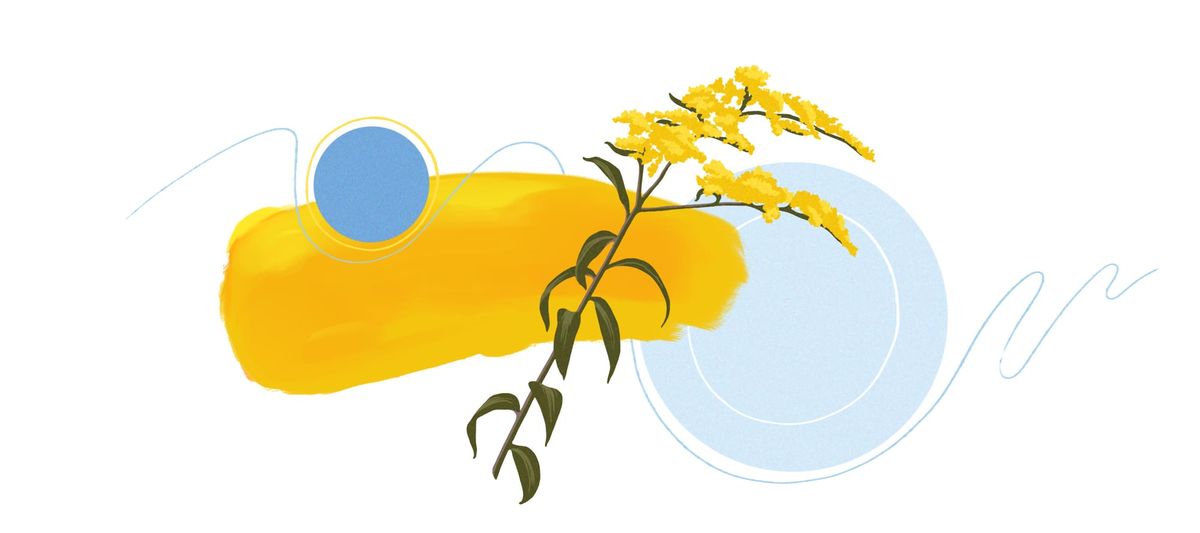
For weeks, my husband and I drive around with two stainless steel bowls and a pair of scissors in the back of our car. Finally, I spot a burst of gold in a weedy patch a few miles from our house.
“You think there’s enough?” My husband, Fausto, asks, voice catching in excitement. We unclip our seat belts and open our doors.
Nodding, I reach into the trunk and pick up the supplies. The late summer heat slides down our backs, making our shirts cling to our shoulders. We jog across the road and wade into the grass so I can collect what I need.
Last month, I took a class where I learned how to make natural dyes. I stood in a room next to other worn-out women, most of whom, like me, had recently left teaching. We learned how to forage for materials and then spent hours simmering pots of sumac berries, goldenrod, and willow bark in an attempt to bring color back into our lives.
The weeds are thicker than we expected, some as high as my thigh. “Be careful of the bugs,” Fausto says. A clutch of gnats swarms around his face. As he brushes them away, I reach the goldenrod patch. But as I bring my scissors to the stems, I second-guess myself.
During our class, the instructor warned us that people sometimes confuse goldenrod with ragweed when they forage. “It’s easy to mistake one for the other, but only goldenrod will make yellow,” she explained as we huddled around her bundle of flowers. When she plunged the goldenrod into the warm water, its many petals yielded a sunny hue.
“This is what you need, right?” Fausto asks in a cautious voice—the same question he asked in early spring when I realized I was burned out and wanted to quit. I’d said yes then so easily. I was certain my exhaustion would evaporate as soon as I emailed my boss.
The sun is starting to make everything hazy. Turning, I look up at Fausto’s face. He smiles, and his crow’s feet bloom. Hidden in those folds is all the stress he carries for me. My lingering burnout. The recent death of a friend.
I bring one of my gloved hands up to his face.
“Yes, this is what I need.” I assure him, quietly.
Then I turn and quickly cut the plant.
Fausto nods and holds out the bowls so I can fill them. I need a few hundred grams to make a dye pot, but I didn’t think to bring a scale, so we guess the weight with our fingers.
Once we’ve gathered what we need, we swim our way out of the weeds and drive back home. I heave a stainless steel pot onto our stove and, with some trepidation, watch the flowers sink into the water. For a moment, they rest at the bottom, sodden.
And then, suddenly, all their brightness unfurls.
Emily Hall’s prose has appeared or is forthcoming in places such as Passages North, Blood Orange Review, Cherry Tree, Does It Have Pockets, Gooseberry Pie Lit Magazine, and 100 Word Story. She’s a prose editor for Pictura Journal and has a PhD in contemporary Anglophone fiction from the University of North Carolina at Greensboro. She lives in North Carolina with her husband and two mischievous pets.
This essay is a Short Reads original.