Rooted
by Robbie Gamble | A boy and his unknowable fears.

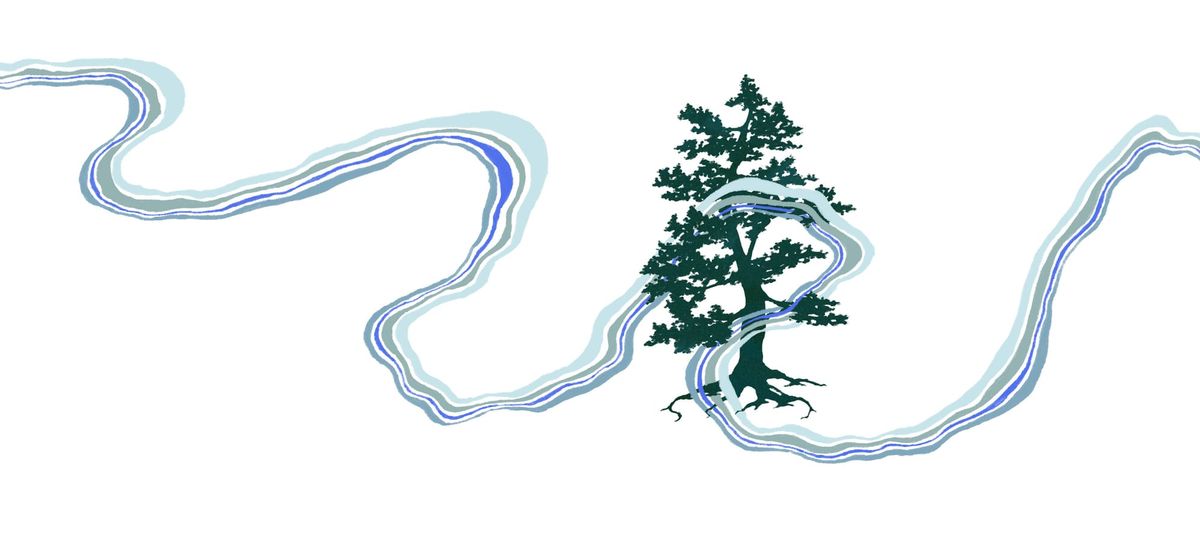
Two miles inland from the mouth of the Kennebec River, where the waters swirl a brackish dance between the rhythmic tidal pressures of the Atlantic Ocean and the steady push of watershed draining out a wedge of central Maine, on the granite flanks of the eastern shore, there stands an ancient cedar tree. This tree is not tall, but it is massive: four or five muscular trunks rising out of a common base of braided roots gripping a low rock ledge just above the high-tide mark. Behind the tree, furry thickets of scarlet sumac bushes slowly fill a clearing, and beyond them a pine-lined ridge heaves up to stand sentinel over this stretch of river. To the west, across a half-mile expanse of water, the postcard-perfect hamlet of Phippsburg nestles under a similarly rugged ridge, a cluster of gray-shingled saltbox houses around a pristine white church spire.
When I was eleven or twelve years old, I sought out this cedar tree for solace, trudging down a mile of gravel road through copses of young beech trees and older hemlock groves, past the mysterious void of an abandoned cellar hole rimmed with ferns, through the sumac-studded field to the river’s edge, where the cedar tree’s trunks arced upwards from their common base like fingers curling loosely over an upturned palm, draped in fine, moss-green foliage. Many times, I climbed down into that beckoning hand to cuddle into its sinewy curves, laying my cheek on its fibrous bark. I would lie there late afternoons, watching the sun sink low toward the far riverbank, casting a rosier glow as it approached the horizon, its rays refracting through the lower swaths of atmosphere to reflect off Kennebec waters and angle up into my cradled hideaway, warming my face for a lingering while.
I carried heavy, preteen boy feelings in my heart in those days, and being a boy, I couldn’t share them with any other human, or even give them dimension, or a name. I knew the feelings were large and steeped in loneliness, shaped by the presence of familiar people who acted out in ways beyond my understanding. There was the girl in my sixth-grade class I wanted to love, but she scorned me. There was my mother, who seemed to carry her own particular weight of sadness around with her, and though she tried to put on a good face and keep a good household and say appropriate motherly things to me and my brothers, she would sometimes be pulled under by her feelings, lost in herself. There was my father, who worked hard to meet his responsibilities at the hospital and care for his patients, always a pager-beep away from another crisis, who threw off subtle signals that he would like to be more kind and loving but didn’t quite know how to express that desire. I sensed, too, that somewhere, secrets were being kept from me.
Boys weren’t supposed to have these wallowing feelings; they were just supposed to take actions and execute them competently, stuff like math and soccer and, later on, interpreting electrocardiograms and assessing heart murmurs and writing research grants; do them all without complaining much or feeling the ache of not being loved enough.
Curled up in the cedar’s roots, aligning my youthful bones with its ancient contours, I could feel my heartaches settle, dilute, seep down into the organic mass of the tree. I imagined the tree absorbing them gently, along with the stream water that trickled down the riverbank, and the moisture from the waves of fog that sometimes rolled inland. I felt secure, held by this living being who had remained serenely rooted to one quiet ledge for centuries, growing incrementally in wisdom, bearing witness to the intersections of ocean and river, land and sky, a small boy and his unknowable fears. The tree didn’t require anything of me beyond my tiny warmth and weight on its roots; it loved me unconditionally through those baffling young years, and when twilight spread across the river and first stars began to ride the rippled waters, I could uncurl myself from its cupped embrace and make my way back up the gravel track toward dinner and home, less afraid of all I couldn’t yet see.
Robbie Gamble’s nonfiction work has appeared in Consequence, Pangyrus, Pithead Chapel, and Tahoma Literary Review. His essay “Exit Wound” was cited as a Notable selection in The Best American Essays 2020. He is the poetry editor for Solstice Literary Magazine, and he divides his time between Boston and an apple orchard in Vermont.
This essay first appeared in Tahoma Literary Review (2020).
From the archive
May 14, 2025
“Sitting at the island in my kitchen”
by Margaret Rozga | Conjuring worlds.