Displacement
by Amanda Fetters | Welcome to the neighborhood.
The first conversation with every neighbor is identical, possibly scripted: We always have a Christmas party the first Sunday in December. There’s a neighborhood text thread—I’ll ask them to add you. Did you know that General Bradley lived in your house?
Occasionally, a neighbor adds that they’ve heard the general’s portrait still hangs in our living room—that it’s rumored the portrait stays with the house, a relic that gets transferred between owners along with the keys and the codes and the collection of old doors in the attic.
The “portrait” is, in fact, a framed cover of Life magazine, April 9, 1951, the man himself in his four-star helmet with his four-star arms folded across his four-star chest, and when we moved in, in the sweat-drenched heat of July, we found it hanging above the doorway to the laundry room. One day, the previous owner’s father stops by to claim a stack of unforwarded mail. He says, perhaps in acknowledgment of the fact that we are an Army family, that he always had his grandchildren salute the general before bedtime.
I decide not to tell him that I removed the general when I painted and tucked him into a cupboard. Nothing hangs there now.
~~~
Despite the excellence of our neighbors’ baked goods, despite their repeated promises to add us to the text thread, despite their most earnest efforts to absorb us into the fabric of the neighborhood, it takes time before we stop feeling like interlopers.
If I’m being honest, the feeling never really leaves.
I try telling a few neighbors that it’s such a funny coincidence about the general, because when we were stationed at Fort Leavenworth, Kansas, our children went to Omar Bradley Elementary. There’s an uncertain beat before the quirk in their brow asks, I thought you moved here from Florida? And I wonder if their smile looks more like a grimace because they’re unsure how to picture our alien family living in alien places that are Not Here. Our ever-shifting placelessness is a puzzle to them.
When I finally meet the neighbor who owns the text thread, he tells us, a little sheepishly, that the number of recipients is at capacity; to add us, he’d have to delete someone else. The neighborhood is a closed system: total mass and energy must remain constant.
~~~
The previous owners leave behind two square garden beds, connected in the center with a sturdy arch of cattle fencing, perfect for growing vining things. The cucumbers are at their zenith when we move in, profligate and fat, covering the arch with a roof of broad, green leaves. Many of the cucumbers have grown yellow and bloated, no good to eat. I toss these into the compost, then harvest the rest to share with the neighbors as a gesture of goodwill.
One neighbor opens the door only a few inches; she doesn’t remember me at first. She wears a fuchsia house dress with embroidered flowers at the collar. I realize, too late, that I’ve made a breach in etiquette by dropping in unannounced. I explain that there’s a bumper crop and she’d really be doing me a favor if she could take one or two.
She remembers that I’m her neighbor, invites me in, insists she really couldn’t take a whole cucumber for nothing, and presses a store-bought apple into my hands. I wonder whether this is due to the never-return-an-empty-plate clause, or whether it’s because I’m a stranger—an unknown entity, someone to whom she does not yet know whether it is wise to be beholden for surplus garden produce. Perhaps it’s simple generosity.
She tells me stories about the neighborhood—the usual bits about General Bradley and about the Christmas party—but this time, there’s also a story about the occasion when an elephant from a traveling circus died and was buried in one of the backyards on this side of the street. It was decades ago; she can’t remember which house.
~~~
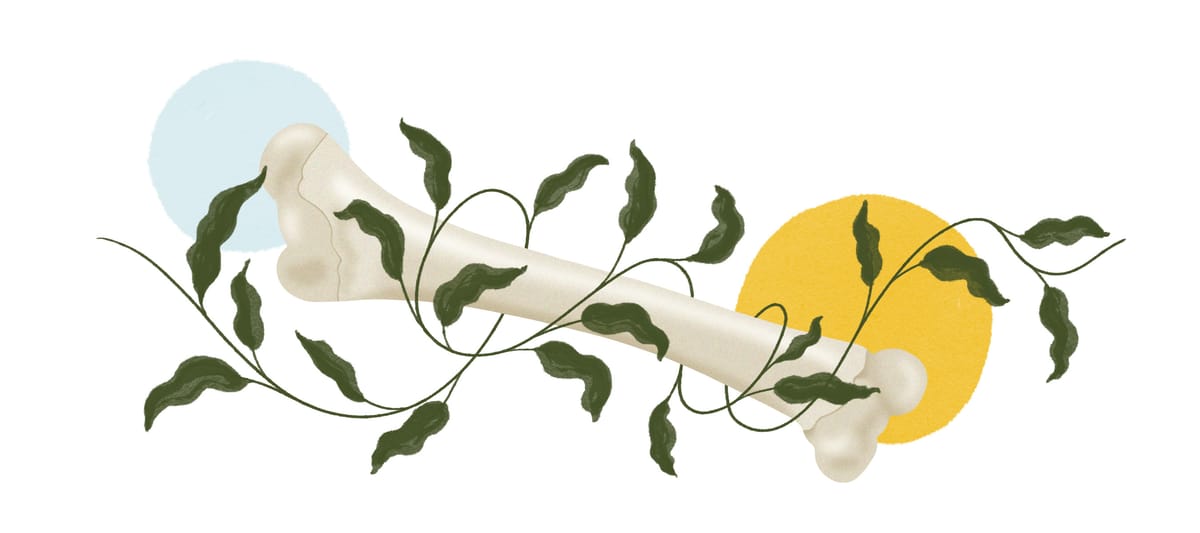
I imagine finding elephant bones in my cucumber bed. I wonder why the animal died and, if the legend is true, how they got it into the backyard. I wonder how deep they had to dig so the stench of decomposing pachyderm wouldn’t plague the whole neighborhood.
I think of men, war vets with crew cuts and cigarettes and undiagnosed PTSD, sinking their shovels into the ground, throwing the packed earth ever higher. Children running saddle-shoed in wild jubilation, daring each other to touch that tough old gray hide, and the women shaking their heads in the kitchen, peering out the gingham-curtained window over the sink and exchanging gossip.
In a flight of speculative fancy, I imagine the worms in my garden are descendants of the worms that fed on that elephant, those worms that enrich my vegetables with their leavings so that I can feed my family and our neighbors with their fruits, bringing us, one cucumber at a time, into that sacred closed system.
I picture the displaced earth mounded over the elephant’s corpse, and General Bradley in his cupboard, and how all things settle—imperceptibly, over time—into their places in this neighborhood where there is always, eventually, space; nothing ever eliminated, only rearranged.
Amanda Fetters is into stories that span our shared human experiences in surprising, hopeful ways. She lives in Louisiana with her family, where she teaches college writing. Her work appears in Abraxas Review, Hearth Stories, and The Lit Nerds. You can also find her on Threads and Instagram at amanda_fetters_writes.
This essay is a Short Reads original.
PS/ We’re looking for flash nonfiction reprints. See the submission call →