Tenderheart
by Joanna Byrd | Feeling sorry for a snake.

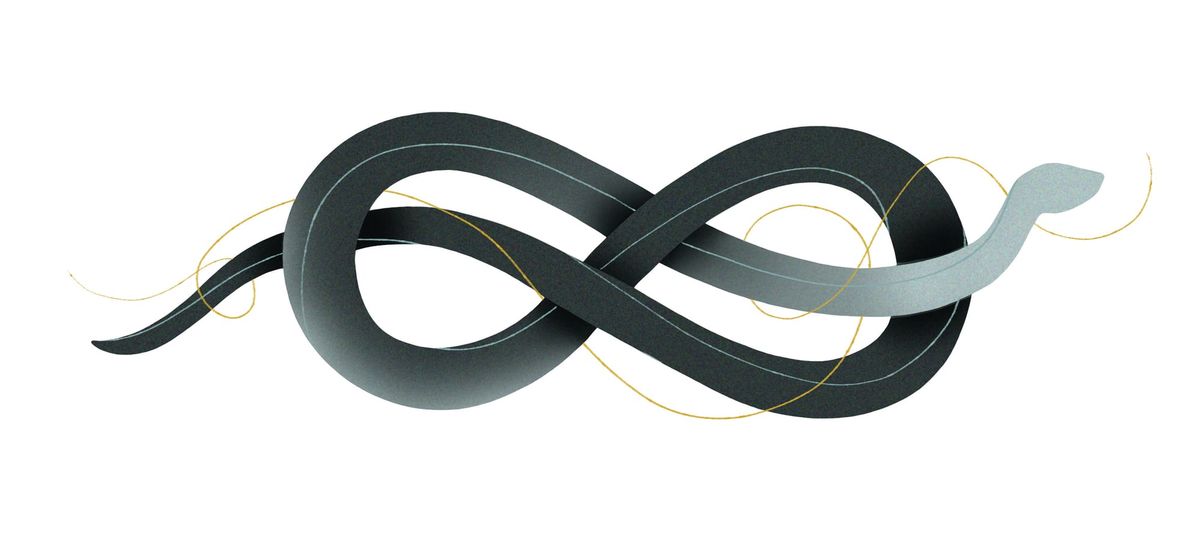
Mama worried most about water moccasins. And sure enough, a cottonmouth camouflaged in muddy water’ll kill a kid quick as a hiccup. We learned that before we learned our letters, growing up in Alabama. But the woods we played in were home to more than one kind of pit viper. It puzzled me then that copperheads didn’t keep her up at night, and I still don’t understand, if I’m honest. Water moccasins kept to the creek, while other snakes, under cover of abandoned outdoor toys and faithfully tended gardens, slithered right up to the house.
But I reckon if you raise your children in a landscape full of serpents, you decide where to draw the line with your worries. So, we never ran out the kitchen door without the ritual call and response: she’d shout at our backs, “Stay outta the creek!” We’d holler the chorus, “Yes, ma’am!”
The week of my seventh birthday, Little Paul’s daddy, Big Paul, killed a snake in the creek. He did it where the water ran through our yard, though. Not theirs. Righteous anger gripped my throat and drove my own fingernails into my defenseless palms.
After he’d done it, he’d forced her slack mouth open with a stick and left her there like a grim monument in the shallow water. Her black skin shone polished-stone-smooth and peculiar, resting on the creek bed. I didn’t want to see in her mouth, but it was bright white, clear down her throat, like a light that drew the eye. That was the point of the stick, after all. Cottonmouth. Big Paul wanted us to see. It’s how Alabama children learn. By afternoon, every kid in the neighborhood had come to gawk and jeer.
It was only an hour after he’d left her there that Little Paul brought the mob. He was the oldest and biggest, and too much like his daddy. He led the march carrying a long, straight stick of his own. When they got down the hill and gathered on the red clay bank, he stabbed through the creek’s surface, aiming for her, but the mud was soft and she yielded, gently bumping away from the point of his weapon. Frustrated, and fueled by the crowd he’d brought with him, Little Paul used the stick instead to hook her and pull her out of the creek. The boys laughed and cheered while her body dangled, then it slid off the stick and the water mercifully took her back.
Little Paul noticed me then, which never worked in my favor. Noticed I wasn’t laughing. I was standing too much apart. In a neighborhood brimming with kids, I was younger than the next youngest by two years, and by some statistical injustice, the only girl. When our eyes met, I bit the inside of my cheek and stared through his eyes to the back of his head. “What’sa matter, little girl?” he hissed. “You feelin’ sorry for that snake?”
Little Paul walked closer, and I turned myself to stone, like maybe the snake had done when Big Paul’s boots towered over her. Eyes fixed, teeth grinding harder into my soft cheek, salt and metal seeping into my mouth. The other boys were busy throwing rocks at the snake, so it was just us two. Little Paul so close now his chest nearly touched my chin. His sweaty heat registered even through the summer afternoon, deepening the red of my sunburned cheeks. He raked the stick, wet from the creek and the snake, across my face. “Tenderheart,” he sneered, and turned away.
The other boys followed him up the hill, finally left me alone with her.
I stayed on the bank for hours and days. I listened for shrieks from the front yard; magnolia pods landing like hand grenades and a certain sort of shouting meant the boys were busy playing war. Only then was it safe to sing to her.
Church songs mostly, since that’s what I knew. I could lay honeysuckles on the surface of the water, too, as long as no one saw me do it. They’d float downstream without raising suspicion. She never floated downstream, though. Not like the flowers anyway. She rested on the bottom, where the water barely moved. Her obsidian shine slipped away by the hour. Her skin grew ghostly and rose in a kind of cloud until I couldn’t see her in it anymore. Until she became the creek itself.
Joanna Byrd is an emerging writer who was born and raised in Alabama. Her life’s work so far includes operating a center for artists with developmental disabilities, serving as program officer at a charitable foundation, and running the morning shift at a 7-Eleven on Route 66 in Albuquerque. She lives in Portland, Oregon, with her wife, nearly grown children, and ever-changing cast of cats and dogs and foster kittens.
This essay first appeared in Buckman Journal #13 (2024).
“‘I Had This in My Office & Thought You Should Have a Photo of the God Mobile’”
by B. J. Hollars | Lessons from a writing teacher.