Shaking Hands with Idi Amin
by Sari Fordham | Doing what you have to do.

My mother stands in the Entebbe airport, a daughter on each side. It is January 1978, and Idi Amin has been up to his usual brutality. He has murdered four college professors, scores of Christians in the southeast, and fifteen high-ranking officials, and these are just the killings reported in The New York Times. Since he has taken power, Idi Amin has killed one hundred thousand Ugandans, or three hundred thousand. Human rights observers aren’t sure.
My mother gently squeezes our hands and tells my sister Sonja and me to “stop staring, for goodness’ sake,” and then she whispers, “You’ve seen people before, haven’t you?” There are more soldiers in the airport than civilians, and in truth, she has never seen anything like this. What are the chances that he is here, too?
We’re in this airport because my Finnish grandmother is dying. My mother received the telegram in Kenya: Come immediately. She and my father considered their options. We had fled Uganda several months earlier, leaving our possessions in storage, but once in Kenya, we didn’t have money for one ticket, let alone three. Somehow, the plan developed: Our family would return to Uganda, sell enough of our belongings to buy tickets to Finland, and then three of us would fly out and my father would take a bus back to Nairobi.
When my father’s boss forbade him from entering Uganda, my mother laughed. “So now it’s too dangerous.” She laughed and laughed, and then she cried. “Never mind,” she said. “I’ll go alone.” What she meant is that she would go without her husband. Of course, she would take us. We were her limbs. Our father, ever pragmatic, nodded.
On the black market in Kampala, my mother sold her wedding gifts. “Never mind,” she said. She moved like a fury and didn’t allow herself to cry for her dying mother. Aiti-aiti-aiti, she thought. Mama-mama-mama. She took the shillings, good only in Uganda, to the Sabena Airline office and booked the earliest flight out.
Now, at the Entebbe airport, we sit at our gate. My mother opens her purse for us, and Sonja and I pin brooches to our T-shirts and smear strawberry ChapStick across our lips.
A soldier approaches. “Excuse me, madam. How are you, madam?”
My mother takes out her Finnish passport, her eyes wild. She assumes Americans are in trouble again and her daughters will be detained. Maybe her citizenship can protect us.
The soldier looks embarrassed. He tells her to put her passport away. “Idi Amin would like to welcome you to Uganda,” he says. We are in the departure lounge. “Would you like to meet him?”
“We’d be honored,” my mother says. There is no other possible answer. She takes a fast brush to our hair and holds out her hands. As we walk through the airport, people turn away, actively minding their own affairs.
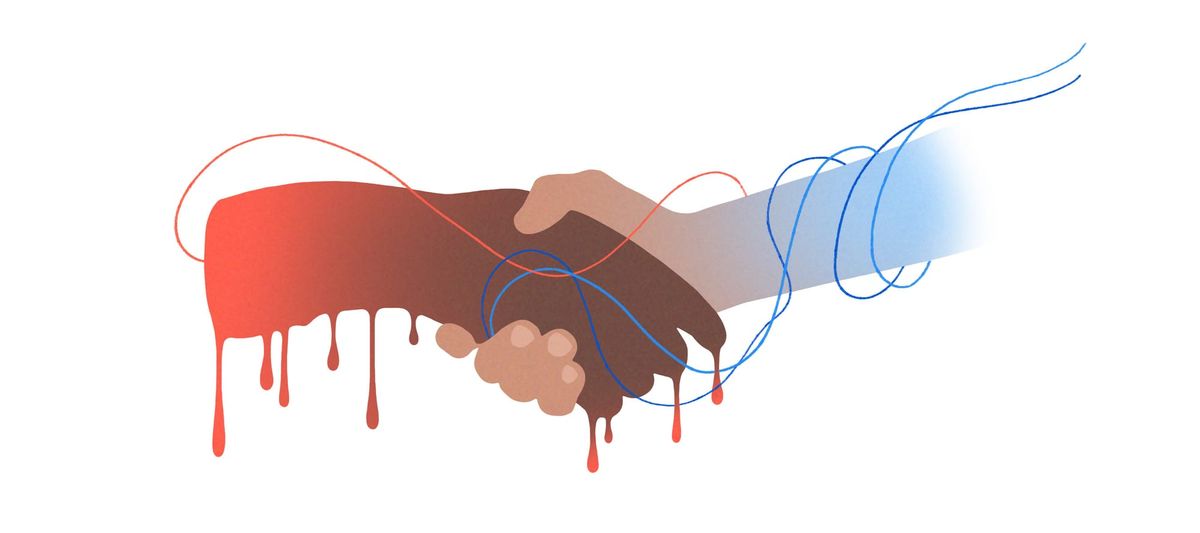
Idi Amin is a large man dressed in khaki and exuding so much charm that he seems to fill the VIP lounge. A few other mzungu are already here, all of them women and children. One of the bodyguards gestures for us to stand in a row, and Amin stops chatting and walks down the line. A man takes photographs. We are political theater. The pictures will show that Uganda is safe. Look at these foreign women bringing their babies here. See how happy they are to meet the president.
When Idi Amin reaches us, he shakes my mother’s hand and says, “You are welcome.” It’s the most Ugandan of greetings. My mother smiles and says thank you.
When Idi Amin reaches for Sonja’s hand, she holds out her left arm. My mother has heard something about a cameraman killed over a left-handed shake. She hisses, “your other hand.” Sonja drops her arm and snorts back tears.
Idi Amin laughs. He’s like a jolly uncle. He bends at the waist and takes Sonja’s left hand in his. “Look at this one,” he says. “You are welcome, little sister.”
When we meet Idi Amin, he is kind and our mother is mean. This is one story.
Here’s another: After we shake hands with Idi Amin, we board a plane to Finland and our mother says goodbye to her mother. At the graveside, she stands between us, holding our hands. The sky is gray with unfallen snow. We have not yet become acclimatized to winter or to our mother’s grief. She smiles down at us. “Move your fingers if they’re cold.”
Years later, our mother will die too young and will reside solely in the land of our memories. Some days, unexpected days, I will wake to the image of her sweeping through the Entebbe airport, holding our hands. Across the span of time, she will call to her daughters and she will tell us that we must always do what we have to do. Never mind the rest.
Sari Fordham is a writer, professor, and environmental activist. Her memoir, Wait for God to Notice, narrates her childhood in Uganda. Her work has appeared in The New York Times, Passages North, Brevity, The Best of the Net series, and Booth, among others. She is the author of a free monthly newsletter, Cool It: Simple Steps to Save the Planet.
This essay first appeared in Passages North (Nov 2017).
From the archive
Jul 30, 2025
“How I See an Owl, Alive in the Face of Things”
by Naomi Cohn | Fake it till you make it.
“Postpartum Madness”
by Judy Bolton-Fasman | The baby is real; everything else is up for grabs.